Your Clients Trust You with Their Finances. Who is Doing the Same for You?
Ontario CPA partners and practice owners face planning complexity that most financial advisors are not equipped to handle. Independence restrictions, partnership buy-sell obligations, IPP and RCA opportunities, and corporate surplus strategy require an advisor who understands your world before walking in the door.
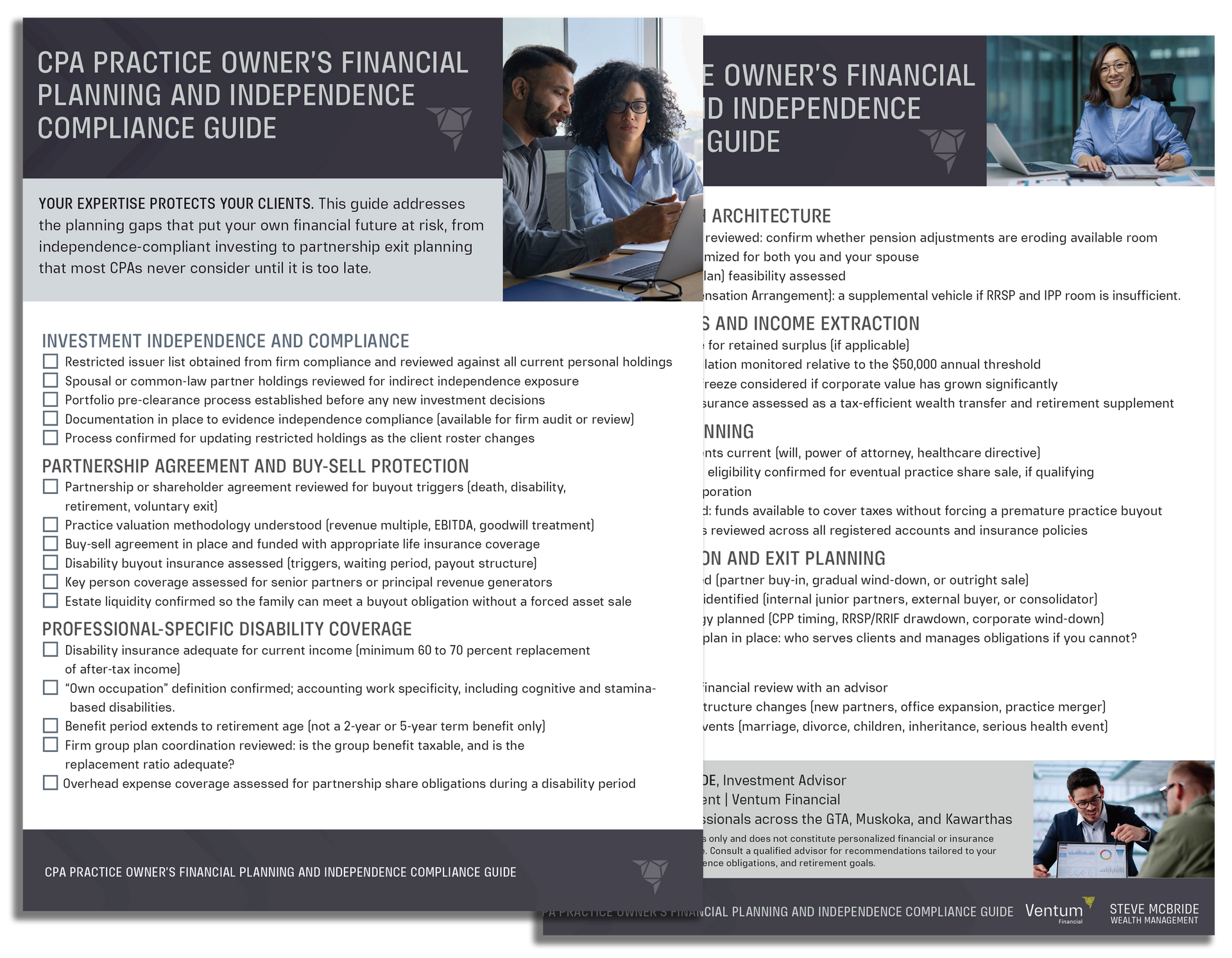
Download the CPA Practice Owner’s Financial Planning and Independence Compliance Guide to receive:
- Independence-compliant portfolio construction, CPA Ontario-aware
- Partnership agreement-aligned disability and buy-sell coverage
- IPP and RCA planning for incorporated partners beyond the RRSP ceiling
- Corporate surplus and passive income threshold strategy
- Practice succession and equity exit planning
By clicking in the consent button, you are agreeing to receive emails and other electronic messages from McBride Wealth Management about market insights, events and services. You may unsubsribe at any time. We only collect your information to send the updates you may request and to manage our relationship with you in line with our Privacy Policy.
WHAT WE LOOK AT
INDEPENDENCE-COMPLIANT INVESTING
Most advisors do not know what a restricted issuer list is, let alone how to build a portfolio around one. CPA Ontario independence standards require assurance practitioners to avoid financial interests in audit clients and related entities. This extends to spousal holdings and, depending on the circumstances, to indirect interests through pooled funds.
The planning process includes independence screening and pre-clearance documentation before any investment decisions are made. That single step sets the relationship apart from every generalist advisor a CPA partner has worked with before.

PARTNERSHIP AGREEMENT-ALIGNED PROTECTION
Your buy-sell agreement contains valuation formulas, disability triggers, payment timelines, and succession obligations. Insurance and liquidity planning should be mapped directly to those terms, not designed in isolation by an advisor who has never read them.
When a partner dies or becomes disabled, the financial fallout runs on the partnership agreement’s timeline. Proper planning aligns insurance coverage amounts, waiting periods, and payout structures to those exact obligations.


CORPORATE SURPLUS STRATEGY
Many CPA partners accumulate retained earnings inside professional corporations or holding companies. Without active planning, passive income from that surplus can erode eligibility for the small business deduction once investment income exceeds $50,000 annually.
Extraction strategy, whether salary, dividends, paid-up capital, or insurance structures, should be reviewed annually and connected to a long-term tax plan.

RETIREMENT ARCHITECTURE BEYOND RRSP
For incorporated CPA partners earning significant income, RRSP room frequently falls short. An Individual Pension Plan (IPP) is a defined benefit pension structure available to incorporated owners that may allow higher tax-deductible contributions than an RRSP, particularly for those over age 40. A Retirement Compensation Arrangement (RCA) provides a further supplemental vehicle where RRSP and IPP limits have been exhausted.
These structures require actuarial coordination and careful integration with corporate compensation strategy. They are among the most powerful planning tools available to a CPA partner building retirement wealth inside a corporation, and they are rarely raised by generalist advisors.
HOW IT WORKS
YOUR NEXT STEPS ARE SIMPLE:
DOWNLOAD YOUR GUIDE
- Enter your email and receive the CPA Practice Owner’s Financial Planning and Independence Compliance Guide immediately. Review the guide at your convenience to identify gaps and confirm what is already in place.
ASSESS YOUR CURRENT STRATEGY
- Use the guide to evaluate your existing plan. Are your investments screened against your firm’s independence requirements? Is your buy-sell agreement properly funded? Have IPP or RCA structures ever been assessed?
SCHEDULE A SECOND OPINION (OPTIONAL)
If you would like a professional review of your current situation, Steve offers short complimentary consultations. No obligation and no sales pitch, just an honest assessment of where you stand and what opportunities may exist.
WANT TO DISCUSS YOUR SPECIFIC SITUATION
If you are unsure whether your current plan addresses your independence obligations, partnership risks, or retirement income ceiling, or if you would like a second opinion on your corporate structure, a short complimentary consultation is available.
During this brief call, we’ll:
- Your current corporate structure, investment holdings, and independence considerations
- Planning gaps or optimization opportunities (IPP, RCA, buy-sell funding)
- Whether coordinated investment and insurance planning makes sense for your situation
- Any questions you have, with no obligation and no pressure

"As a dual-licensed advisor I can take a holistic view of your financial situation, aligning investment and insurance solutions so your entire plan works together toward long-term goals. This integrated approach gives CPA’s comprehensive planning without the complexity of coordinating multiple advisors.” – Steve McBride
WHAT MAKES STEVE MCBRIDE DIFFERENT
THE DUAL-LICENSED ADVANTAGE
Most financial advisors hold either an investment licence or an insurance licence. Steve McBride holds both. That means he can review your investment portfolio and your disability, life, and buy-sell insurance coverage in a single conversation, providing a complete picture rather than a fragment. When those two areas are coordinated, the planning is more efficient, coverage gaps close, and you work with one advisor who sees the whole picture.
CPA-SPECIFIC KNOWLEDGE
Steve has experience with independence restrictions, partnership income structures, IPP and RCA planning mechanics, and the complexity of unwinding a professional corporation at retirement. He works with professionals who expect their advisors to understand their world before the first meeting.
INTEGRATED PLANNING APPROACH
Your practice exit strategy should align with your RRSP and IPP drawdown sequence. Your corporate surplus should be coordinated with your estate plan. Your disability coverage should map to your partnership agreement’s buy-out terms. Most advisors address one area in isolation. The goal here is to coordinate all of them.