The Three Pillars of Retirement Income Every Canadian Should Understand
For many Canadians approaching retirement, the question that keeps them up at night is not "Did I invest well?" It is something far more urgent: Will my wealth last as long as I do?

Research by CPP Investments found that 61 per cent of Canadians fear running out of money in retirement. That concern is well-founded. Canadians are living longer than ever, with many now spending 25 to 30 years in retirement, roughly as long as an entire working career. Add inflation that steadily erodes purchasing power, healthcare costs that rise with age, and market volatility that can destabilize even well-built portfolios, and the challenge is clear: building retirement income is a fundamentally different exercise than building retirement savings..
Learn more about me and my
services here.
The Shift From Saving to Spending limit
During your working years, the goal is straightforward: save as much as possible, reinvest, and let compounding work. Retirement flips that equation entirely. Your portfolio must now generate reliable income for decades while simultaneously protecting purchasing power and managing risk.
This is where many retirees stumble. An overly conservative approach fails to keep pace with inflation. An overly aggressive one exposes the portfolio to risks that time can no longer correct. The goal is a disciplined decumulation strategy that delivers steady income, preserves purchasing power, and maintains enough flexibility to absorb unexpected shocks.
Three income sources are central to getting this right for most affluent Canadians: government benefits, registered accounts, and insurance-based solutions.
Pillar 1: Government Benefits Require a Strategy
CPP and OAS are the only retirement income sources that are guaranteed for life and indexed to inflation. Most Canadians treat them as an afterthought, but the timing of when you start these benefits may be one of the most consequential decisions in your retirement plan.
Taking CPP early reduces your benefit substantially. Waiting until age 70 increases it by 42 per cent compared to taking it at 65. For affluent Canadians with significant RRSP balances, deliberately delaying CPP while drawing from registered accounts in the early retirement years can produce a considerably better tax outcome over a lifetime.
OAS adds another layer of complexity. Once your net income exceeds a set threshold (approximately $90,997 in 2025), OAS benefits begin to be clawed back at 15 cents per dollar. Strategic RRIF withdrawal planning and TFSA usage can help keep income below that threshold and preserve benefits worth thousands of dollars annually.
Pillar 2: Your Registered Accounts Are Not a Simple Piggy Bank
Most Canadians know what an RRSP, TFSA, and RRIF are. Far fewer understand how to draw from them in a sequence that minimizes taxes and maximizes lifetime wealth.
The 4% rule, a widely cited retirement guideline, suggests withdrawing 4 per cent of your initial portfolio annually, adjusted each year for inflation. It was developed in the 1990s using U.S. market data, and while it remains a useful benchmark, it was not designed with Canadian tax structures, OAS clawback rules, or current market conditions in mind. In practice, a more conservative approach of 3 to 3.5 per cent may be appropriate, depending on your personal circumstances.
What matters as much as the withdrawal rate is the sequencing. Which accounts you draw from first can have a significant impact on your lifetime tax bill, government benefits eligibility, and the size of your estate. This requires ongoing coordination and regular review, not a one-time decision.
Pillar 3: Insurance and Annuities Provide a Floor
Annuities and insurance-based products are often overlooked in retirement income planning, but they serve a purpose that investment portfolios cannot: guaranteed income for life. An annuity eliminates longevity risk entirely, providing a stable income floor regardless of market conditions or how long you live.
For business owners and high-net-worth families, permanent life insurance with cash value accumulation can also serve as a supplementary income source, offering tax-deferred growth and flexible access through policy loans. As a dual-licensed advisor holding both investment and insurance licences, I am able to integrate these solutions directly into a comprehensive retirement income plan rather than treating them as separate products with separate advisors.
The Cost of Getting This Wrong: RRSP Checklist for affluent Canadians
One of the most underappreciated risks in retirement is sequence-of-returns risk: the damage caused by poor market performance in the early years of retirement when withdrawals are actively reducing the portfolio. Two retirees with identical long-term average returns but different sequences of early returns can end up with dramatically different outcomes. This risk, combined with inflation and rising healthcare costs, is why retirement income planning demands ongoing attention, not just pre-retirement preparation.
Go Deeper With The Retirement Blueprint
This article introduces the core framework, but sustainable retirement income requires considerably more depth than any single article can provide. I have published The Retirement Blueprint: Building Income That Lasts a Lifetime, a comprehensive white paper that walks through withdrawal strategies, tax-efficient drawdown sequencing, portfolio construction for decumulation, and a real-world case study of a 60-year-old couple building a coordinated income plan.
Download The Retirement Blueprint HERE.
If you would like to discuss how these principles apply to your specific situation, I invite you to book a complimentary 20-minute consultation. Retirement income planning works best when it starts before you need it.
If you are a client, thank you for taking the time to read this and I look forward to our next conversation. Please feel free to share this with your friends and family who may be in need of another viewpoint.
If you are looking for a second opinion on your portfolio or would like to have a planning conversation tailored to your needs, book a no-obligation complimentary portfolio review with me today.
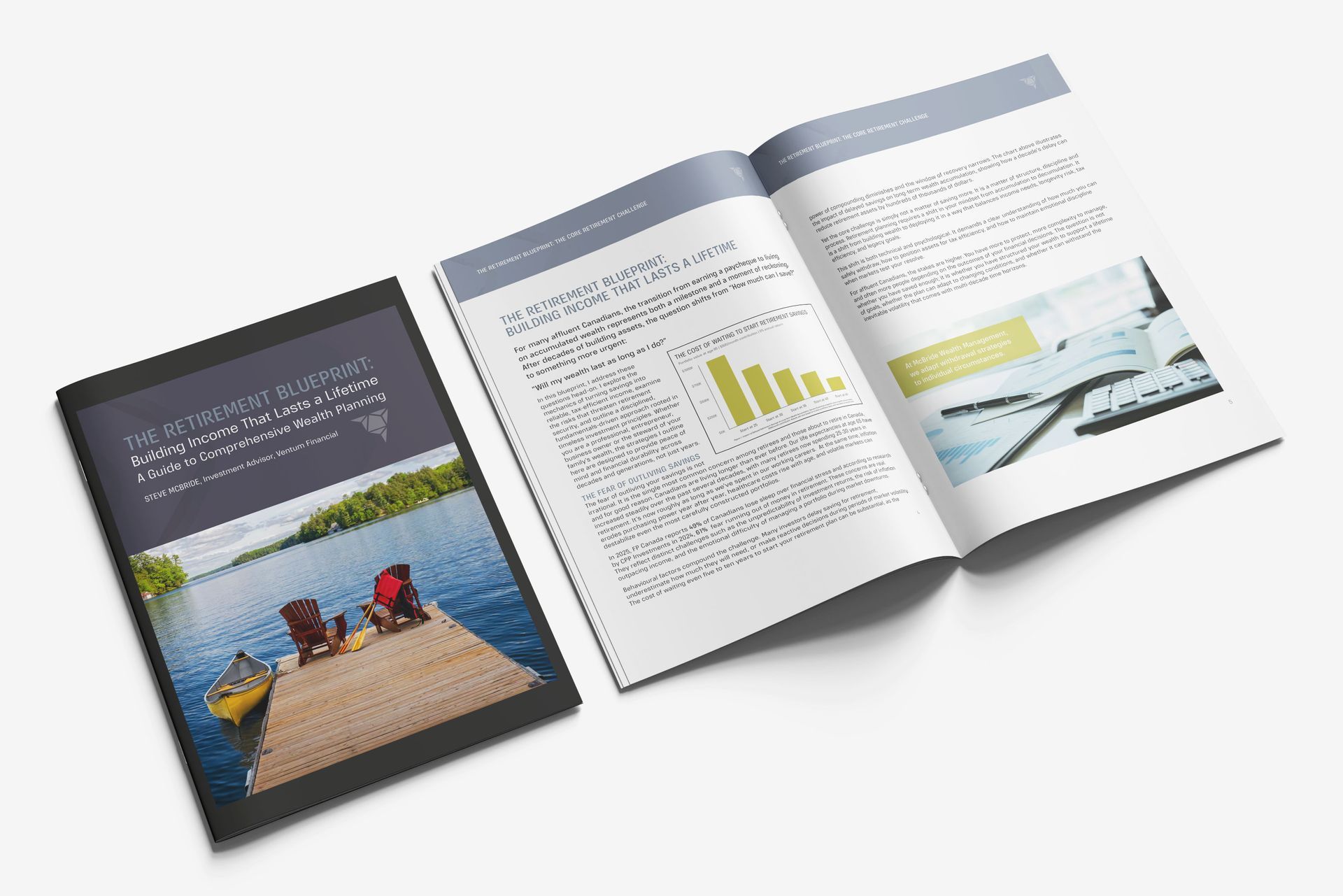
Source
McBride, Steve. The Retirement Blueprint: Building Income That Lasts a Lifetime. McBride Wealth Management / Ventum Financial Corp., 2025.
Ventum Financial Corp. www.ventumfinancial.com
Vancouver Office
2500 - 733 Seymour Street
Vancouver, BC V6B 0S6
Ph: 604-664-2900 | Fax: 604-664-2666
For a complete list of branch offices and contact information, please visit our website.
Participants of all Canadian Marketplaces. Members: Canadian Investment Regulatory Organization, Canadian Investor Protection Fund and AdvantageBC International Business Centre - Vancouver. Estimates and projections contained herein are our own and are based on assumptions which. we believe to be reasonable. Information presented herein, while obtained from sources we believe to be reliable, is not guaranteed either as to accuracy or completeness, nor in providing it does Ventum Financial Corp. assume any responsibility or liability. This information is given as of the date appearing on this report, and Ventum Financial Corp. assumes no obligation to update the information or advise on further developments relating to securities. Ventum Financial Corp. and its affiliates, as well as their respective partners, directors, shareholders, and employees may have a position in the securities mentioned herein and may make purchases and/or sales from time to time. Ventum Financial Corp. may act, or may have acted in the past, as a financial advisor, fiscal agent or underwriter for certain of the companies mentioned herein and may receive, or may have received, a remuneration for their services from those companies. This report is not to be construed as an offer to sell, or the solicitation of an offer to buy, securities and is intended for distribution only in those jurisdictions where Ventum Financial Corp. is registered as an advisor or a dealer in securities. Any distribution or dissemination of this report in any other jurisdiction is strictly prohibited.
For further disclosure information, reader is referred to the disclosure section of our website.
Share this post