The Missing Link in Retirement Planning: Disability and Critical Illness Coverage
Most retirement plans account for markets, taxes, and longevity. Few account for what happens to your wealth if your health gives out first.

You have spent years building wealth, including maximizing contributions, staying disciplined through market cycles, and making careful decisions about when and how to deploy capital. Your retirement plan accounts for inflation, withdrawal sequencing, and estate planning. But there is one risk most retirement plans do not address clearly: what happens if a serious illness or injury stops you from working at 47, 52, or 58?
According to Statistics Canada's 2022 Canadian Survey on Disability, nearly one in four working-age adults aged 25 to 64 reported living with a disability that limited their daily activities. The Society of Actuaries estimates that more than one in four workers will experience a long-term disability lasting 90 days or more before reaching age 65. The Canadian Cancer Society estimates that two in five Canadians will develop cancer in their lifetime. These are not remote possibilities. They are statistically common events that most retirement plans treat as afterthoughts.
Learn more about me and my
services here.
The financial cost of a health event in peak earning years
The real risk is not the health event itself. It is the compounding financial damage that follows when income stops during the years when wealth accumulation should be accelerating the most. The years between 50 and 65 typically bring peak earnings, reduced family expenses, and maximum compounding momentum. A significant disruption at this stage does not create a short-term cash-flow problem; it creates a retirement shortfall that rarely recovers.
This is where many retirees stumble. An overly conservative approach fails to keep pace with inflation. An overly aggressive one exposes the portfolio to risks that time can no longer correct. The goal is a disciplined decumulation strategy that delivers steady income, preserves purchasing power, and maintains enough flexibility to absorb unexpected shocks.
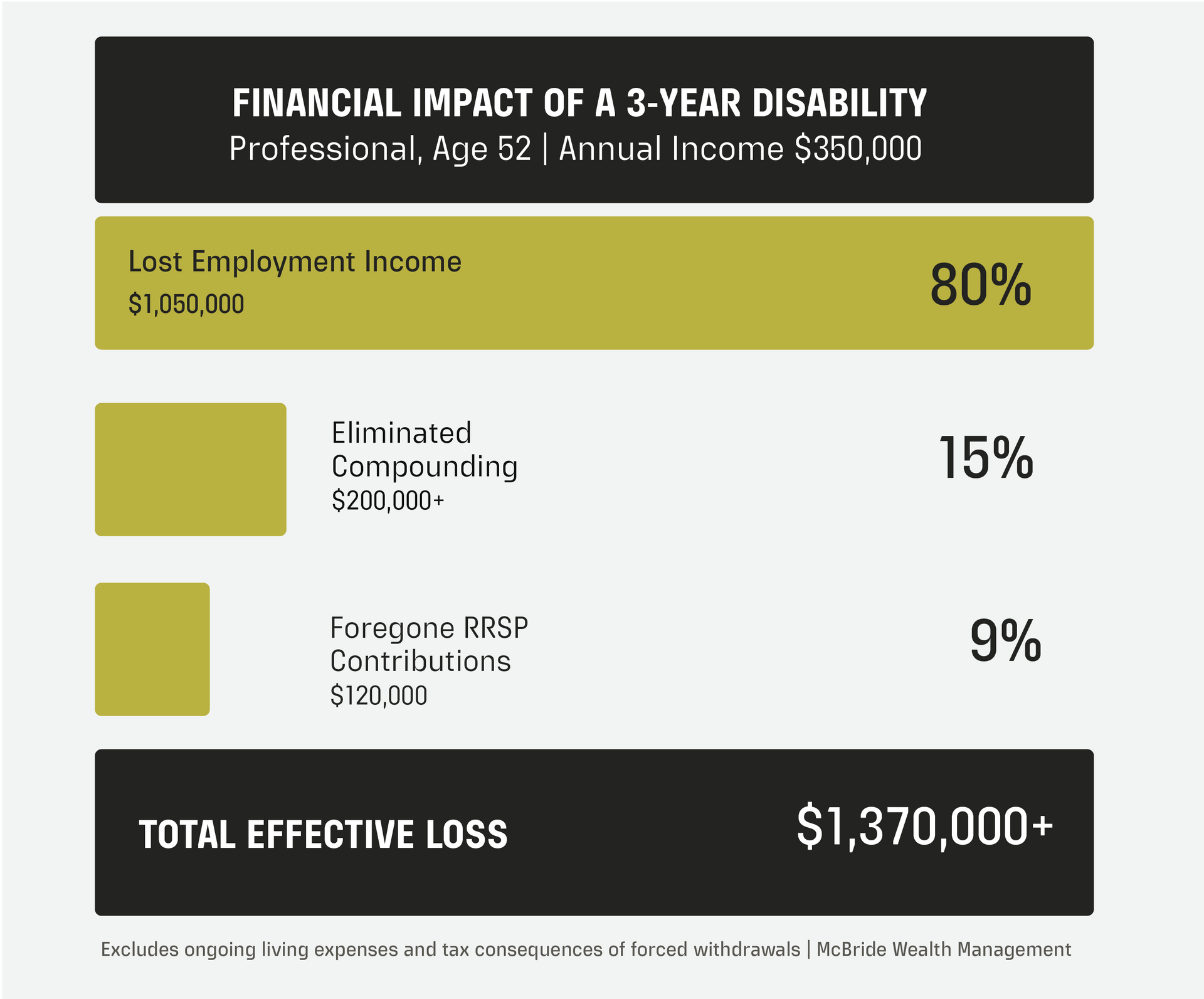
Illustrative example only. Figures are hypothetical and for educational purposes. Individual outcomes will vary based on income, contribution history, investment returns, and personal circumstances.
Group long-term disability benefits typically replace only 60 to 70 per cent of pre-disability income, often capped at a level well below what a senior professional earns. Self-employed professionals and incorporated business owners frequently have no disability coverage unless they arrange it independently. According to the Canadian Life and Health Insurance Association, Canadian insurers paid $143.3 billion in claims in 2024, a figure that reflects both how common these events are and how consequential they become without adequate protection in place.
How disability derails retirement savings
Beyond income replacement, a multi-year disability triggers a chain of secondary financial consequences that most Canadians do not anticipate. RRSP contributions stop, eliminating both the deposit and the years of compounding that would follow. Registered account withdrawals, forced by cash flow pressure, create immediate tax consequences and permanently reduce the asset base. TFSA contribution room lost to forced withdrawals is not recovered. For incorporated business owners, a disability may also disrupt corporate income streams or destabilize a professional corporation structure that took years to build.
Individual disability insurance with an own-occupation definition addresses this by replacing income at a level calibrated to actual earnings, preserving the capacity to continue building retirement wealth rather than liquidating it.
Critical illness coverage protects three things
A common misconception is that critical illness insurance exists to pay medical bills. In Canada, provincial health plans cover the primary treatment costs for conditions such as cancer, heart attack, and stroke. The financial damage comes from disruption. A critical illness policy pays a one-time, tax-free lump sum upon diagnosis of a covered condition, which the policyholder can direct to any financial priority.
Three things it protects:
- Recovery time. A serious diagnosis may require months or years away from generating active income. The lump-sum benefit creates a financial buffer that allows recovery without drawing down RRSP or TFSA assets out of sequence.
- Business continuity. For incorporated professionals and business owners, a health crisis can threaten client relationships, revenue, and operational obligations. A critical illness benefit can fund interim staffing, debt servicing, or partnership requirements during a recovery period that group benefits do not cover.
- Retirement savings continuity. A benefit sized to reflect the retirement account shortfall from a multi-year contribution gap allows the professional to maintain registered account contributions, avoiding both the tax cost of early withdrawals and the compounding loss that follows.
Disability and critical illness insurance are not interchangeable. Disability insurance replaces income over time. Critical illness insurance delivers a lump sum at diagnosis. Both serve distinct roles in a comprehensive retirement protection strategy.
Integration with the retirement income strategy
Disability and critical illness coverage are most effective when they are calibrated components of the broader retirement income plan, not standalone products purchased separately. The key questions are:
- Does the disability coverage replace income at a level that allows continued contributions to registered accounts, not merely living expenses?
- Is the critical illness benefit sized to reflect the retirement shortfall a multi-year contribution gap would create?
- Are coverage structures aligned with the life stages where financial risk is highest?
This integration is where most professionals find their current planning falls short, not because the intention was absent, but because the investment and insurance conversations typically happen with different advisors who do not coordinate with each other.
A coordinated approach
As a dual-licensed Investment Advisor and licensed life insurance professional through Ventum Insurance Services Corp., I can evaluate both the investment and insurance dimensions of a client's plan in a single, coordinated conversation. Most clients work with an investment advisor who does not hold an insurance licence, or with an insurance agent who does not have access to the investment portfolio. These two advisors rarely speak to each other, and the gap between them is where wealth erosion during a health event tends to happen.
My role is to look at your retirement trajectory and your current coverage together, identify the points at which a disability or critical illness would cause the most financial damage, and build a strategy that addresses both sides in an integrated way. Through Ventum Insurance Services Corp., I have access to a range of disability, critical illness, and life insurance products from reputable Canadian insurance companies, matched to your specific situation rather than limited to a single provider.
Request a complimentary coverage review
If you are between 40 and 60 and have not had a formal insurance coverage review as part of your retirement plan, the time to address it is before a health event, not after. I invite you to book a complimentary 20-minute consultation to discuss whether your current disability and critical illness coverage aligns with your retirement income goals.
If you are a client, thank you for taking the time to read this and I look forward to our next conversation. Please feel free to share this with your friends and family who may be in need of another viewpoint.
If you are looking for a second opinion on your portfolio or would like to have a planning conversation tailored to your needs, book a no-obligation complimentary portfolio review with me today.
For a broader framework on how retirement income, tax strategy, and protection planning work together, download The Retirement Blueprint at mcbridewealthmanagement.ca.
Source
Statistics Canada. New Data on Disability in Canada, 2022. Government of Canada, Dec. 1, 2023. https://www150.statcan.gc.ca/n1/pub/11-627-m/11-627-m2023063-eng.htm
Statistics Canada. Accessibility in Canada: Results from the 2022 Canadian Survey on Disability. Government of Canada, May 28, 2024. https://www150.statcan.gc.ca/n1/daily-quotidien/240528/dq240528b-eng.htm
Statistics Canada. Labour Market Characteristics of Persons with and Without Disabilities, 2024. Government of Canada, May 14, 2025. https://www150.statcan.gc.ca/n1/pub/71-222-x/71-222-x2025001-eng.htm
Canadian Cancer Society. Canadian Cancer Statistics at a Glance. Canadian Cancer Society, updated 2024. https://cancer.ca/en/research/cancer-statistics/cancer-statistics-at-a-glance
Canadian Institute for Health Information. Taking the Pulse: A Snapshot of Canadian Health Care, 2024. CIHI, 2024. https://www.cihi.ca/en/taking-the-pulse-a-snapshot-of-canadian-health-care-2024
Canadian Life and Health Insurance Association. Claims in Canada Rising: $143.3 Billion Paid to Help Keep Canadians Healthy and Financially Secure. CLHIA, Sept. 23, 2025. https://www.clhia.ca/en-ca/media-and-publications/news-releases/2025/Claims-in-Canada-rising-143-billion-paid-to-help-keep-canadians-healthy-and-financially-secure
Society of Actuaries. Long-Term Disability Incidence Study. Society of Actuaries, 2021. https://www.soa.org/resources/research-reports/2021/disability-incidence/
McBride, Steve. The Retirement Blueprint: Building Income That Lasts a Lifetime. McBride Wealth Management, 2026. https://www.mcbridewealthmanagement.ca/
Ventum Financial Corp. www.ventumfinancial.com
Vancouver Office
2500 - 733 Seymour Street
Vancouver, BC V6B 0S6
Ph: 604-664-2900 | Fax: 604-664-2666
For a complete list of branch offices and contact information, please visit our website.
Participants of all Canadian Marketplaces. Members: Canadian Investment Regulatory Organization, Canadian Investor Protection Fund and AdvantageBC International Business Centre - Vancouver. Estimates and projections contained herein are our own and are based on assumptions which. we believe to be reasonable. Information presented herein, while obtained from sources we believe to be reliable, is not guaranteed either as to accuracy or completeness, nor in providing it does Ventum Financial Corp. assume any responsibility or liability. This information is given as of the date appearing on this report, and Ventum Financial Corp. assumes no obligation to update the information or advise on further developments relating to securities. Ventum Financial Corp. and its affiliates, as well as their respective partners, directors, shareholders, and employees may have a position in the securities mentioned herein and may make purchases and/or sales from time to time. Ventum Financial Corp. may act, or may have acted in the past, as a financial advisor, fiscal agent or underwriter for certain of the companies mentioned herein and may receive, or may have received, a remuneration for their services from those companies. This report is not to be construed as an offer to sell, or the solicitation of an offer to buy, securities and is intended for distribution only in those jurisdictions where Ventum Financial Corp. is registered as an advisor or a dealer in securities. Any distribution or dissemination of this report in any other jurisdiction is strictly prohibited.
For further disclosure information, reader is referred to the disclosure section of our website.
Share this post